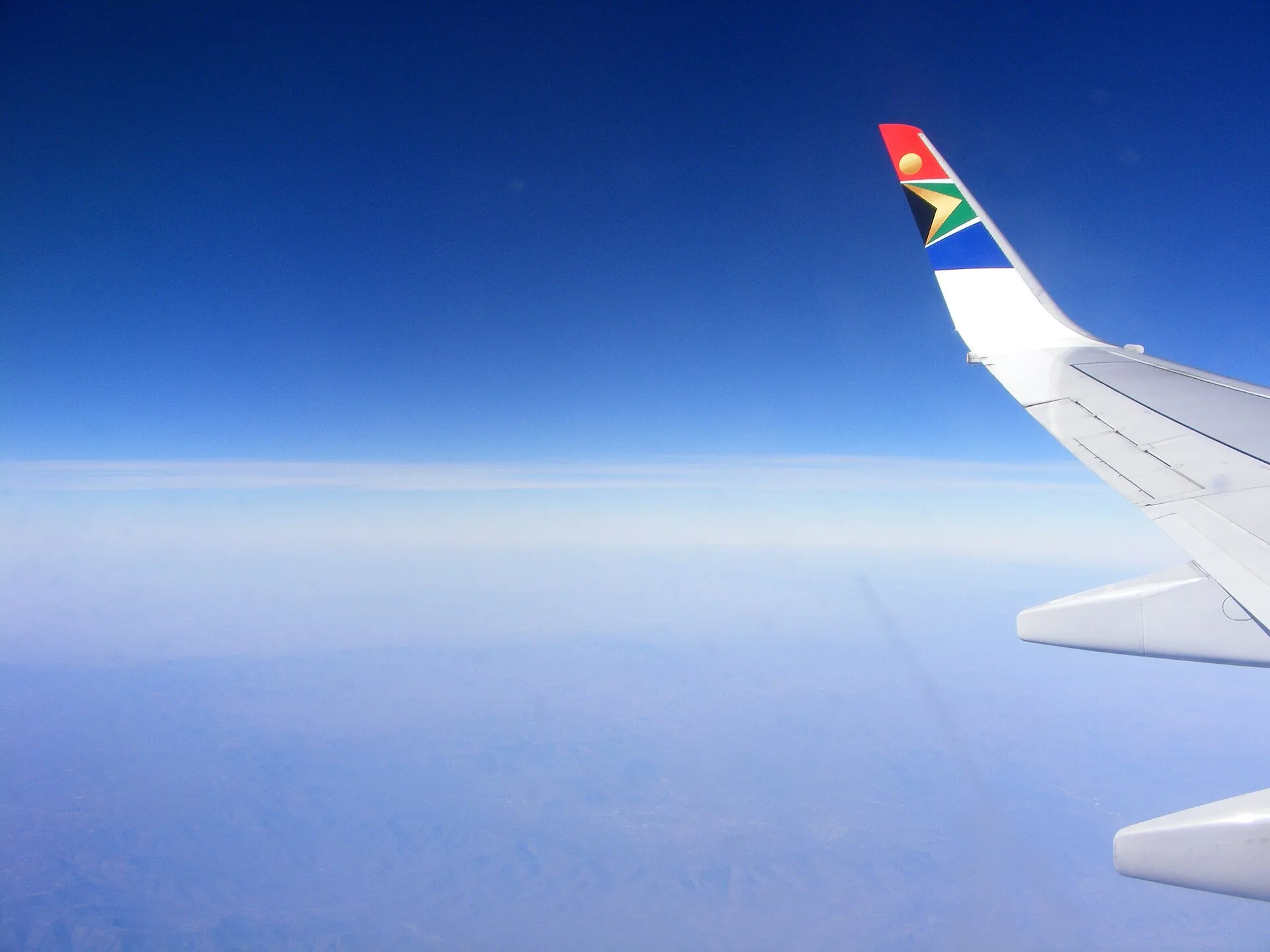
The South Africa airport guide
Why the weather delays the wrong airports
Photo: fading, Wikimedia Commons (CC BY-SA 3.0)

Cape Town delays in winter. Johannesburg delays in summer. The two biggest airports in South Africa have opposite risk seasons, for reasons that are structural rather than random — and that makes them something you can book around.
At a glance
- Cape Town risk season
- May to August
- Johannesburg risk season
- November to March
- Cape Town main runway
- 01/19, 3,201 m
En route
Photo: fading, Wikimedia Commons (CC BY-SA 3.0)
Cape Town is a winter problem
Cape Town has two runways on paper, but only 01/19, at 3,201 m, is long enough for the jets. The second, 16/34, is 1,701 m. So when weather affects the main runway there is nowhere to switch to.
The weather in question is the north-westerly frontal systems that arrive between May and August, bringing crosswind and low cloud. A morning departure in those months is a safer bet than an afternoon one, because the fronts typically build through the day.
Johannesburg is a summer problem
O. R. Tambo sits on the Highveld at 5,558 feet, and the Highveld thunderstorm season runs from roughly November to March. The storms are sharp, localised and usually late afternoon.
What they stop is not flying so much as ground handling: lightning in the vicinity halts ramp work, so loading, refuelling and pushback stop, and the delay propagates through the rest of the day’s rotations. A flight at two o’clock is far less exposed than the same aircraft’s fourth rotation at six.
Booking around it
- Cape Town, May to August — take the morning flight.
- Johannesburg, November to March — take the early flight, and avoid being on the last rotation of the day.
- Connections through either in those windows — add an hour to what you would otherwise consider safe.
The smaller airports are less exposed, with one exception: George sits in the same winter-rainfall belt as Cape Town, and low cloud over the Outeniqua mountains can affect approaches between May and August.
What we do not publish
We do not publish on-time performance percentages. The figures that circulate are compiled on inconsistent bases and are frequently out of date, and a delay statistic from two years ago tells you nothing about tomorrow. The structural facts above — one usable runway at Cape Town, thunderstorms on the Highveld — do not change.
The one-runway problem at Cape Town, in detail
Cape Town International has two runways and the second one is the reason the first one matters so much. 01/19 is 3,201 m. 16/34 is 1,701 m. Only the first is long enough for the jets that carry essentially all the traffic, so in operational terms this is a single-runway airport with a second strip that cannot help it.
An airport with two usable runways on different headings can switch when the wind turns. Cape Town cannot. When a north-westerly front comes through between May and August, bringing crosswind on 01/19 and low cloud over the approach, there is no alternative configuration — only a reduced arrival rate, and a queue that builds behind it for the rest of the day.
That is why the Cape delay season is the quiet season: Cape Town’s June trough is 46 per cent below its December peak, the biggest swing of any major South African airport, and June is also the wettest and windiest month. The fares are low for a reason, and the reason is on the airfield. The month-by-month figures.
The Highveld thunderstorm, and why it is an afternoon event
Johannesburg’s risk runs on the opposite calendar and the opposite clock. O. R. Tambo sits at about 1,700 m on the Highveld, where the summer pattern from November to March is a clear hot morning, convective build-up through the middle of the day, and a short violent thunderstorm in the late afternoon or early evening.
These storms rarely close the airport for long. What they do is stop ground handling — lightning within a certain radius suspends refuelling, loading and marshalling — and thirty minutes of that during the evening departure wave propagates through the rest of the night as aircraft and crews fall out of position.
The practical reading is the same at both airports and it is unusually simple: in the season that airport is exposed, fly in the morning. Winter out of Cape Town, summer out of Johannesburg.
What a delay costs you, and what it does not
The damage a delay does depends almost entirely on how you booked, not on how long it is.
- One ticket: if a delay makes you miss a connection, the airline rebooks you onto the next available service at no charge. The delay is an inconvenience.
- Two separate tickets: nobody sold you a connection. The second airline sold you a seat on a flight that left. You buy a new one, at the counter, on the day, which is the most expensive way to fly in South Africa.
- Either way: the Johannesburg–Cape Town corridor is one of the busiest in the southern hemisphere, so there is usually another departure within two or three hours. That frequency is the real protection.
We publish no on-time performance percentages on this site. Those figures are compiled on different bases by different sources, go stale within a season, and would not change any decision you can actually make. The runway length at Cape Town and the altitude at Johannesburg do not go stale, which is why those are what this page gives you instead.
Common questions
Why does Cape Town airport get delays in winter?
North-westerly fronts between May and August bring crosswind and low cloud, and only one runway is long enough for the jets. There is no second runway to switch to.
Why does O. R. Tambo get delays in summer?
Highveld thunderstorms from November to March. Lightning in the vicinity stops ramp work, which delays loading and pushback and propagates through the day.
Is a morning or afternoon flight safer in South Africa?
Morning, at both Cape Town in winter and Johannesburg in summer. Fronts build through the day at the Cape, and Highveld storms are typically late afternoon.
Checked 1 November 2026. Where a figure moves — a fare, a tariff, an opening hour — we say so rather than publish a number we cannot stand behind today. How we source and check everything on this site.
Why can Cape Town not just use its other runway?
Because it is too short. Runway 01/19 is 3,201 m and carries essentially all the traffic; 16/34 is 1,701 m and cannot take the jets. When weather affects the main runway there is no alternative configuration to switch to, only a reduced arrival rate.
Does a thunderstorm close O. R. Tambo?
Rarely for long. What it does is suspend ground handling — lightning within a certain radius stops refuelling, loading and marshalling — and half an hour of that during the evening departure wave spreads through the rest of the night as aircraft and crews fall out of position.
Will the airline pay for a hotel if I am delayed overnight?
If both flights are on one ticket and the airline caused the misconnection, it is responsible for rebooking you and its conditions of carriage set out what else it provides. If you booked the two flights separately, nobody sold you a connection and the cost is yours. That distinction, fixed when you book, matters far more than the length of the delay.