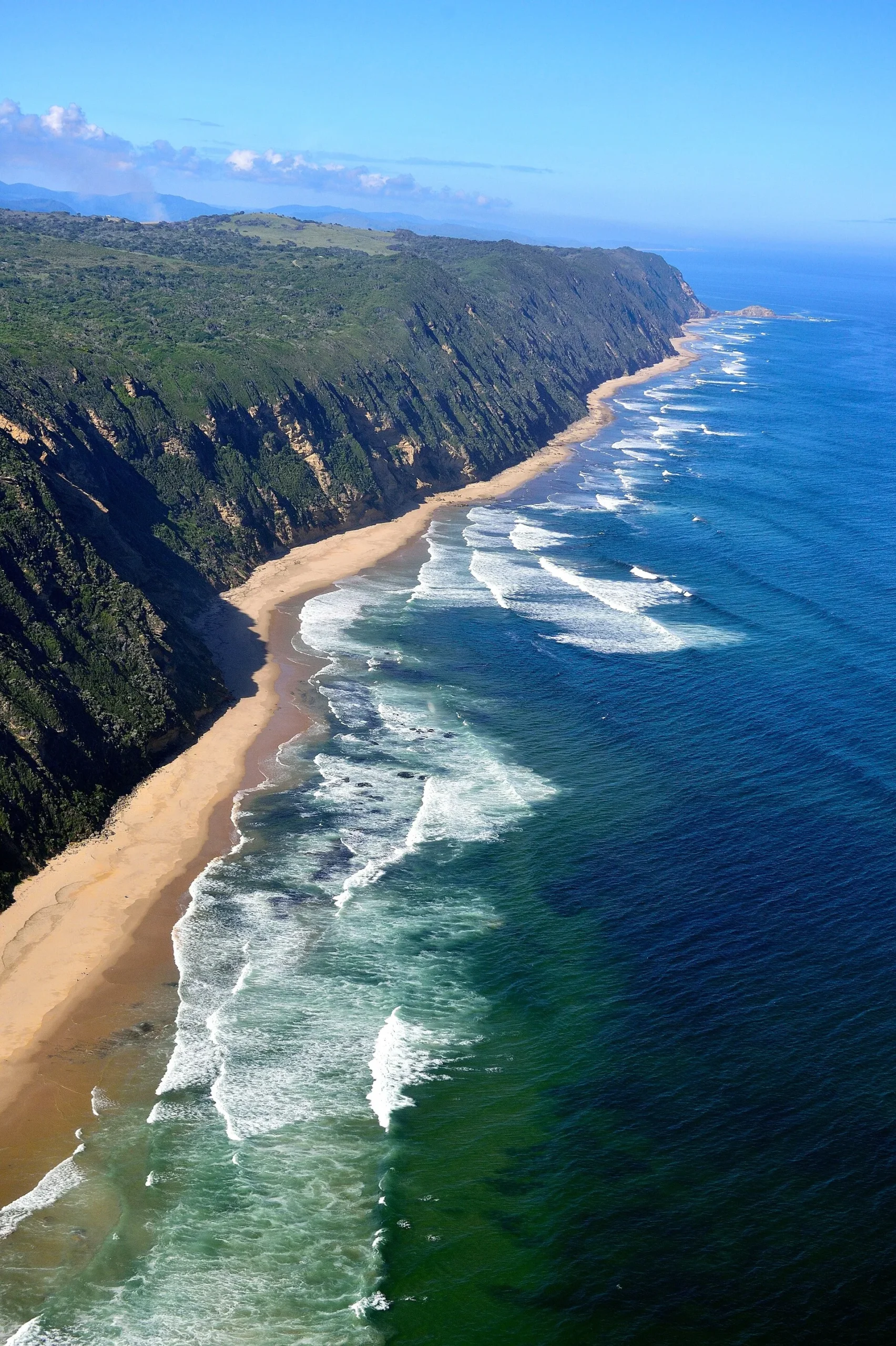
The short answer: June is the cheapest month to fly to Cape Town, February is the quietest month in Johannesburg and Durban, and October is far busier than almost anyone expects. Those three statements are not opinions about weather. They come from the passenger counts that South Africa’s airport operator files every month for each of its nine airports, which we read directly. This page sets out what those counts show, month by month and airport by airport, and what to do with it when you book.
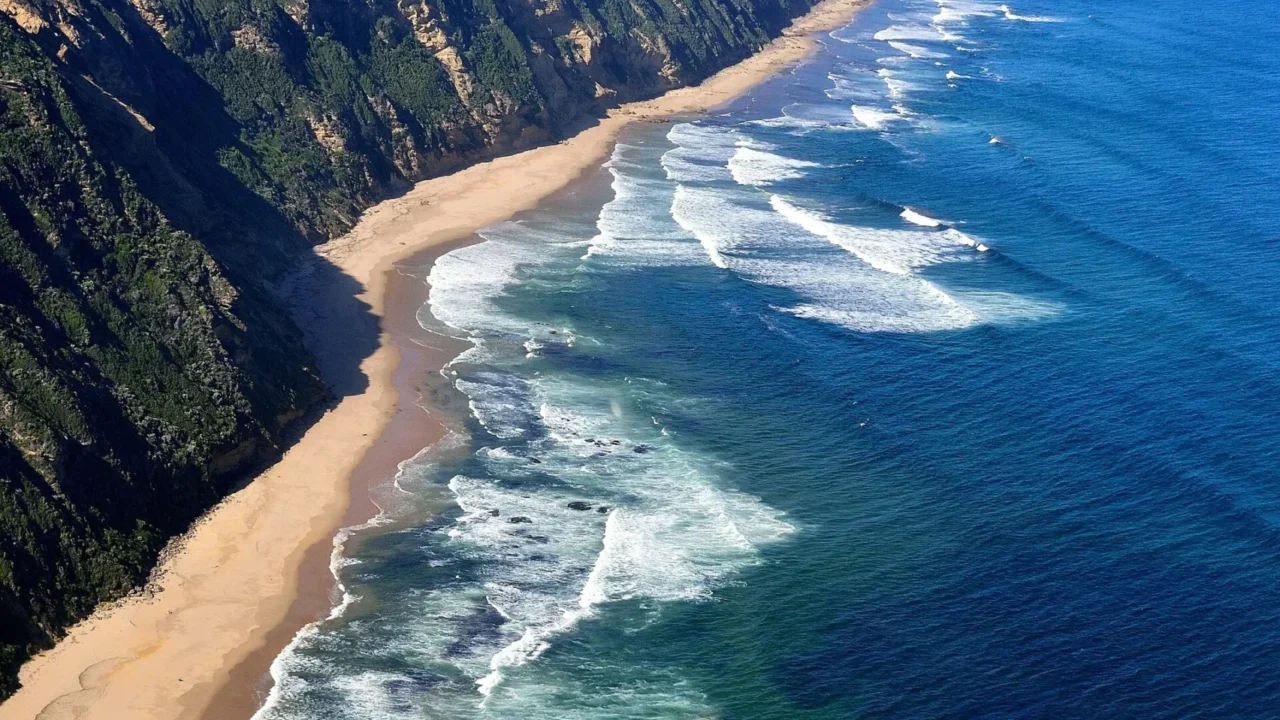
The Garden Route
Photo: South African Tourism from South Africa, Wikimedia Commons (CC BY 2.0)

At a glance
- Busiest month, nationally
- December — 4,013,840 passengers
- Quietest month, nationally
- June — 3,008,907 passengers
- Gap between them
- 33 per cent
- Second-busiest month
- October, and almost nobody expects it
- Quietest month at Cape Town
- June, 46 per cent below its December peak
- The three interior airports
- Peak in March, not December
South Africa does not have a dead season
Start with the single most useful fact, because it changes how you should think about the whole question. Across the nine airports that file monthly returns, the busiest month of 2025/26 carried 4,013,840 passengers and the quietest carried 3,008,907. That is a gap of about 33 per cent.
Thirty-three per cent sounds like a lot until you compare it with somewhere genuinely seasonal. A Mediterranean beach destination can move by a factor of five or six between August and January. South Africa moves by a third. There is no month in which the country shuts, no month in which the flights thin out to a trickle, and no month in which you will have the Garden Route to yourself because nobody else came.
Two things follow from that. The first is that the difference between a good month and a bad month to travel is a difference of degree, not of kind — which is liberating if your dates are fixed by work or school. The second is that the national average hides the real variation, which is at the level of the individual airport. Cape Town swings by 46 per cent. Upington swings by 76. East London barely swings at all. The rest of this page is about those differences, because that is where the useful decisions live.
The month-by-month picture, nationally
These are the actual network totals for the 2025/26 South African financial year, which runs from 1 April to 31 March. Reading them in order tells you more than any single ranking.
- April — 3,444,588. Above average, and higher than you would guess. Easter and the school holidays sit here.
- May — 3,087,229. The second-quietest month of the year. The first genuinely good value window.
- June — 3,008,907. The quietest month in the country.
- July — 3,306,627. A clear rebound: mid-year school holidays and the northern-hemisphere summer.
- August — 3,338,549. Steady.
- September — 3,348,861. Steady, and the weather improves markedly.
- October — 3,755,492. The second-busiest month of the entire year.
- November — 3,417,743. A dip before the storm.
- December — 4,013,840. The peak.
- January — 3,560,948. Still busy: the holiday runs into the new year here.
- February — 3,214,922. The post-holiday trough.
- March — 3,637,518. A surprising third place, and the reason is explained below.
October is the month everybody gets wrong
Nothing in the conventional advice about South Africa prepares you for October being the second-busiest month of the year, 25 per cent above the June trough and within seven per cent of December itself. It is not a school-holiday month and it is not a summer month. So why is it full?
Three things land on top of each other. Spring in the Cape is at its best, with the Namaqualand flowers and the end of whale season on the Overberg coast. The southern-hemisphere conference and business-travel calendar runs hard between the mid-year break and the December shutdown, and October is its densest month. And the northern-hemisphere escape season has begun: Europeans leaving a darkening autumn are the first wave of the long-haul season, arriving before the December crowds and before December prices.
What to do with that. If you are choosing between October and December for a first visit, October gives you comparable weather in the Cape, a fuller calendar of things happening, and fares that have not yet gone through the December roof. What it does not give you is an empty airport. Book accommodation earlier than you think you need to.
The coast peaks in December. The interior peaks in March.
Here is the finding that almost no travel guide carries, because it only becomes visible when you read all nine airports separately rather than the national total.
Six of the nine airports are busiest in December: O. R. Tambo, Cape Town, King Shaka, Chief Dawid Stuurman, George and King Phalo. That is the southern-hemisphere summer holiday, and specifically the coastal exodus — the inland cities emptying towards the sea between mid-December and the first week of January.
The other three — Bram Fischer in Bloemfontein, Kimberley and Upington — peak in March. And their quietest months are not winter either. Kimberley and Upington are at their emptiest in January, the month half the country is on the move.
The explanation is that these airports do not carry holidaymakers. They carry people whose travel follows the business and agricultural calendar: the Free State and Northern Cape harvest, the mining and farming service economy, provincial government and the courts. March is when that calendar is busiest and the financial year is closing. January is when it has not started yet. Their traffic is, in effect, the inverse of everybody else’s.

The Northern Cape
Photo: paffy, Wikimedia Commons (CC BY-SA 2.0)

How much each airport actually swings
The spread — the gap between an airport’s busiest and quietest month, as a percentage of the quietest — is the number that tells you whether timing your trip is worth any effort at all.
- Upington: 76 per cent. The most seasonal airport in the country by a wide margin. Peak March, trough January.
- Kimberley: 53 per cent. Peak March, trough January.
- Cape Town: 46 per cent. Peak December, trough June. The largest swing of any major airport, and the one that matters most to visitors.
- George: 43 per cent. Peak December, trough June. The Garden Route follows Cape Town closely.
- Gqeberha: 39 per cent. Peak December, trough June.
- King Shaka, Durban: 32 per cent. Peak December, trough February.
- O. R. Tambo: 31 per cent. Peak December, trough February. The flattest of the big three, because business travel never stops.
- East London: 26 per cent and Bloemfontein: 26 per cent. The two steadiest airports in the country.
Read that list as a guide to effort. If you are flying to Cape Town or the Garden Route, moving your trip by a few weeks genuinely changes what you pay and how crowded it feels. If you are flying to Bloemfontein or East London, it barely matters, and you should choose on weather alone.
June in Cape Town: the real trade-off
Cape Town in June is 46 per cent below its December peak. That is the single biggest value window in South African travel, and the airport’s own figures prove it rather than a fare-comparison site implying it. The city is quiet, the restaurants take bookings, Table Mountain has no queue and the accommodation rates are a different market from the ones you see in December.
The trade-off is weather, and it is a real one. June is the wet, windy end of the Cape winter, and it carries a specific operational risk that is worth understanding rather than just being warned about.
Cape Town has two runways but only one of them is usable by airliners. Runway 01/19 is 3,201 m. The second, 16/34, is 1,701 m and too short for the jets. So when a north-westerly front brings crosswind and low cloud, there is no second runway to switch to and departures back up. A two-hour delay out of Cape Town in June is not unusual, and it is the reason the Cape has a winter delay problem while Johannesburg’s risk season is the opposite — the Highveld afternoon thunderstorms from November to March.
If you go in June, fly in the morning. The fronts and the cloud tend to build through the day, and a morning departure out of Cape Town is meaningfully more likely to leave on time than an afternoon one. If you have an international connection in Johannesburg that evening, consider flying up the night before.
June also has something December does not: the southern right whales arrive on the Overberg coast, around Hermanus and De Hoop, from roughly June and stay into the spring. The quietest month at the airport is also the start of the single best wildlife spectacle in the Western Cape, which is not a coincidence that the fare data will ever tell you.
February: the quiet month that is not winter
At O. R. Tambo and King Shaka, the quietest month of the year is February — not June, and not the middle of the South African winter. This catches northern-hemisphere visitors out constantly, because the instinct is that the quiet season must be the cold one.
It is not, for a simple reason: in Johannesburg and Durban the great majority of traffic is domestic, and domestic traffic follows the South African school year rather than the European holiday calendar. By February the December holidays are long over, the schools are back, the summer humidity on the KwaZulu-Natal coast is at its most oppressive, and nobody is going anywhere. The airports empty.
For a visitor that is an opportunity rather than a warning. February in Johannesburg is warm, the afternoon storms are dramatic and short, the Kruger is green and the game is harder to spot but the birding is at its best. February in Durban is hot and humid, but the Indian Ocean on that coast is swimmable all year, which is the thing that distinguishes Durban from the Cape in any month.
The seasonality is foreign visitors, not South Africans
One more finding falls out of the same filings, and it reframes everything above.
The monthly returns split traffic into international, regional and domestic. When you follow the international line alone, it runs from 827,033 passengers in June to 1,181,959 in December — a swing of about 43 per cent, against the 33 per cent of the network as a whole.
In other words, the seasonality of South African air travel is overwhelmingly an international phenomenon. South Africans fly at a fairly steady rate all year, for work and for family. It is long-haul arrivals that cluster into the southern summer. The crowd you meet at Cape Town in December is substantially a foreign crowd, and the crowd you do not meet in June is substantially the same foreign crowd, at home.
That is useful because it tells you what you are actually competing for in each season. In December you are competing with other foreign visitors for coastal accommodation and restaurant tables. In June you are not competing for those at all — but you are sharing domestic flights with South African business travellers, whose numbers barely moved.
Flying in
Only three South African airports see international passengers
This is the single most useful thing to understand about the network, and almost nobody states it plainly. In the 2025/26 financial year, scheduled international traffic was recorded at exactly three of the nine state-operated airports.
In practice that means a long-haul arrival reaches the Garden Route, the Eastern Cape or the Free State on a domestic connection through Johannesburg or Cape Town. Budget for it, and for the bag re-check that sometimes comes with it.
Total passengers, FY2025/26. Source: ACSA monthly passenger movements. How we check these.
Photo: fading, Wikimedia Commons (CC BY-SA 3.0)

The dates that actually move the airports
Monthly totals smooth over the thing that will determine whether your particular Tuesday is calm or chaotic. Within each month, three kinds of date do the work.
South African school holidays
These are the single biggest driver of domestic traffic, and they are set per province, with the coastal and inland provinces running on slightly different calendars. There are four terms, which means four holiday blocks: a short one around Easter, a longer one in late June and July, a short one at the end of September or early October, and the long summer break from early December into the second week of January. The December block is the one that produces the peak, and the June–July block is the reason the mid-year trough recovers so sharply in July.
Public holidays, and the long weekends they create
South Africa has twelve public holidays: New Year’s Day, Human Rights Day on 21 March, Good Friday, Family Day on the Monday after it, Freedom Day on 27 April, Workers’ Day on 1 May, Youth Day on 16 June, National Women’s Day on 9 August, Heritage Day on 24 September, the Day of Reconciliation on 16 December, Christmas Day and the Day of Goodwill on 26 December. Where one falls on a Sunday, the following Monday is a public holiday too.
The cluster in late April is worth planning around specifically: Freedom Day on the 27th and Workers’ Day on 1 May sit four days apart, and in years when they fall conveniently a great many South Africans take the days in between. That is a large part of why April is a busier month than its position in the calendar suggests.
The day of the week, and the hour of the day
Even in the quietest month, the 06:00 to 08:00 domestic bank at O. R. Tambo is the worst queue in the country, because that is when the business shuttle to Cape Town and Durban departs. Friday afternoons and Sunday evenings are the heaviest domestic periods of any week. If your dates are fixed but your flight times are not, moving a departure to the middle of a weekday does more for your experience than moving the trip by a month.
The wildlife calendar runs against the beach calendar
If the point of the trip is game rather than coastline, the entire logic above inverts, and it inverts in your favour.
The Lowveld — the Kruger National Park and the private reserves alongside it — has a wet summer and a dry winter. In the dry months from roughly May to September the bush thins out, the seasonal water disappears and the animals concentrate on the permanent rivers and waterholes. Game is easier to find, easier to see and more predictably located. In the green summer months from November to March the bush is thick, water is everywhere and the animals disperse; the birding is at its best and the landscape is spectacular, but you work much harder for a sighting.
Put that against the airport figures and the result is unusually convenient: the best months for game viewing are the quiet-to-average months at the airports, and the peak December month is one of the harder ones for seeing animals. A July safari is both easier and cheaper to reach than a December one.
Getting there shapes the timing too. The Lowveld is served by Kruger Mpumalanga International, outside Mbombela, and by Skukuza inside the park itself — both privately run, neither of which files the monthly returns the state airports do, which is why they do not appear in any of the figures on this page. Most visitors reach them on a domestic connection through Johannesburg, so the O. R. Tambo transfer still applies.

The Lowveld
Photo: BlogDeBanderas, Wikimedia Commons (CC BY-SA 4.0)

A month-by-month recommendation
Putting the airport figures together with what is actually happening on the ground:
- Best value, Cape and Garden Route: May and June. The airport trough, whales arriving, lowest rates, highest delay risk.
- Best compromise overall: September and October. Spring in the Cape, dry season in the Kruger, good weather almost everywhere — but October is the second-busiest month, so book ahead.
- Best for wildlife: July to September. The dry season concentrates game around water in the Lowveld, and the airports are at their mid-year average rather than their peak.
- Best for an empty Johannesburg or Durban: February. The national trough for those two airports, warm, and the cheapest domestic fares of the year.
- Avoid unless you have a reason: mid-December to the first week of January. The peak of the peak, on the coast especially. Everything is full and everything costs more.
- If you are going to the interior — Bloemfontein, Kimberley, Upington — invert all of this. March is their busiest month and January their quietest.
Common questions
What is the cheapest month to fly to South Africa?
June, on the evidence of the airports’ own passenger counts. It is the quietest month across the network at 3,008,907 passengers, and at Cape Town it runs 46 per cent below the December peak. Fares and accommodation follow demand, and demand is lowest then. The cost is weather: June is the wet, windy end of the Cape winter and carries the highest delay risk of the year.
When is the busiest time at South African airports?
December, which carried 4,013,840 passengers in 2025/26 across the nine airports that publish monthly figures. The peak within that peak is the fortnight from mid-December, when the coastal holiday traffic is at its heaviest. October is the second-busiest month of the year.
Is winter a bad time to visit South Africa?
Not generally. The Cape winter is wet and the delay risk is higher, but the Lowveld and the Kruger are in their dry season, which is the best time of the year for game viewing, and the KwaZulu-Natal coast stays warm. The quietest airport months in Johannesburg and Durban are not in winter at all — they are in February.
Why is October so busy at South African airports?
Because three things coincide: spring in the Cape, the densest part of the southern-hemisphere conference and business calendar, and the first wave of northern-hemisphere visitors leaving an autumn behind. The result is 3,755,492 passengers, the second-highest month of the year and within seven per cent of December.
Which South African airport is the most seasonal?
Upington, which moves 76 per cent between its busiest and quietest month. Kimberley follows at 53 per cent. Both peak in March rather than December, because their traffic follows the business and agricultural calendar of the interior rather than the coastal holiday season. The steadiest are East London and Bloemfontein, at 26 per cent each.
When should I go to see whales in South Africa?
Southern right whales are on the Overberg coast, around Hermanus and De Hoop, from roughly June into the spring. That overlaps precisely with the quietest and cheapest window at Cape Town International, which is the most useful coincidence in South African travel planning.
Where these figures come from
Every passenger figure on this page is taken from the monthly passenger-movement statements that Airports Company South Africa publishes for each of the nine airports it operates. We read the statements directly rather than quoting a press release, and we check that the international, regional, domestic and unscheduled lines add up to the printed total before publishing anything. For all nine airports in 2025/26 they reconcile to the passenger.
One caution about any passenger number you read anywhere, including here. The South African financial year runs from 1 April to 31 March, so a figure for “2025” may be a calendar year or a financial year, and the two are different. Cape Town handled 11,333,736 passengers in the 2025/26 financial year and 11,113,490 in calendar 2025. Both are correct, and they are more than 200,000 apart. A passenger figure published without the period it covers is worth very little.
We publish no fares on this page, and that is deliberate: airfares and accommodation rates are the fastest-rotting information in travel, and a number we cannot stand behind today is worse than no number. What we can stand behind is demand, which is what the airport counts measure. The full sourcing note sets out where each class of figure comes from.
Related reading: every South African airport by the numbers, the Cape Town airport page, why Cape Town delays in winter and Johannesburg in summer and which airport to fly into.