The South Africa airport guide
The Traveller Declaration and your duty-free allowance
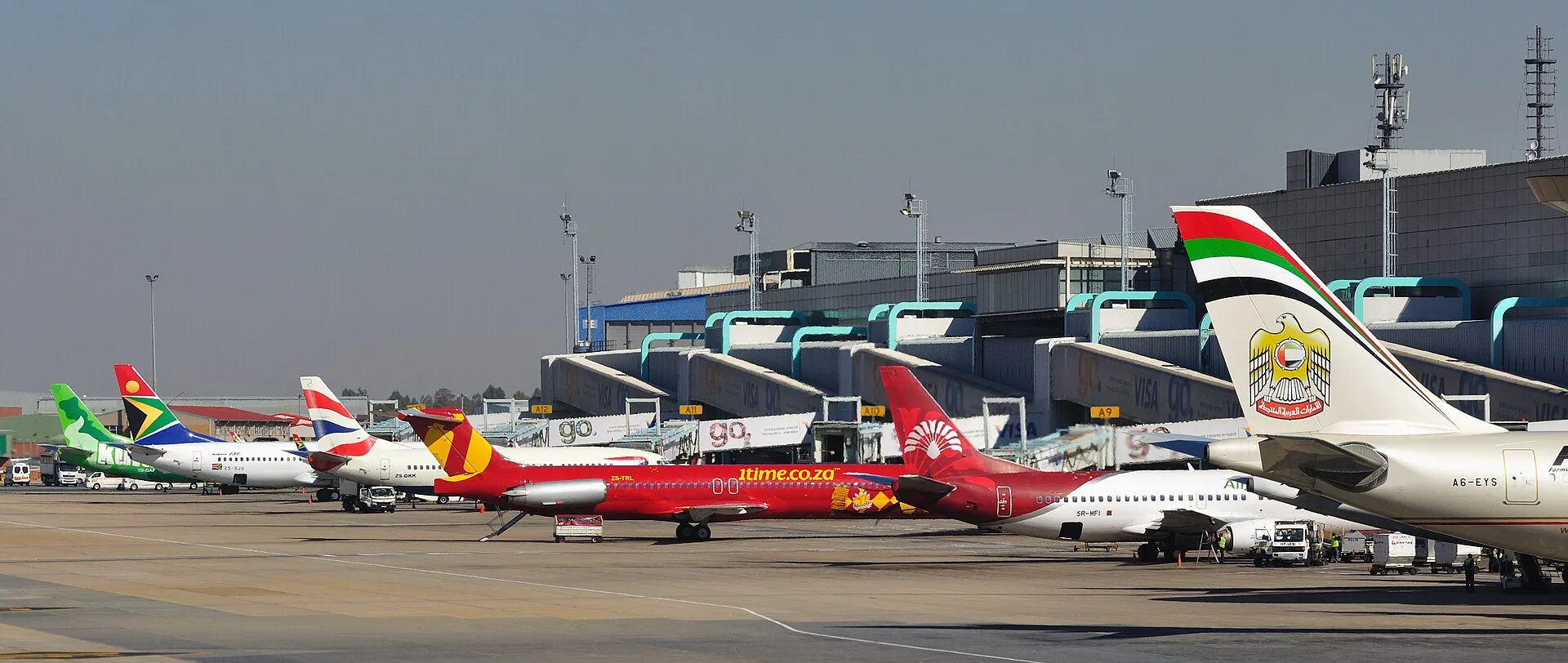
Photo: Hansueli Krapf, Wikimedia Commons (CC BY-SA 3.0)

Most holiday travellers walk through the green channel at O. R. Tambo or Cape Town without filling in anything. But the thresholds that decide whether that is the right channel for you are narrower than people expect, they are enforced, and two of them — the thirty-day rule and the forty-eight-hour rule — catch out regular travellers rather than tourists. Here is what South African customs actually allows, taken from the South African Revenue Service’s own traveller pages.
At a glance
- Goods allowance
- R5,000 duty-free
- Wine
- 2 litres
- Spirits & other alcohol
- 1 litre total
- Tobacco
- 200 cigarettes + 20 cigars + 250 g
Arrivals
Photo: Bob Adams from Amanzimtoti, South Africa, Wikimedia Commons (CC BY-SA 2.0)

The Traveller Declaration, and when you actually need it
South Africa runs a Traveller Declaration through SARS, the revenue service. The main route is an online form completed before you arrive; travellers who could not do that can still declare at the Customs counter on arrival, using the manual form (SARS refers to it as TD-01).
You must complete it if you are carrying goods to declare. If you have nothing to declare, completing it is voluntary. In practice that means most tourists arriving with clothes, a laptop and a camera do not fill in a form at all — but anyone carrying gifts, commercial samples, goods above the allowances below, or currency above the reporting threshold does.
At the airport you then choose a channel. The red channel is for anyone with goods to declare, with prohibited or restricted goods, with goods over the duty-free allowance, or who is not sure. The green channel is for travellers with nothing to declare. Where an airport has no channels — which is the case at several of the smaller South African airports — you go to the Customs counter instead.
“Not sure” means red. SARS lists uncertainty itself as a reason to use the red channel. Declaring something that turns out to be within your allowance costs you a few minutes. Being found in the green channel with something over it costs you the goods and a penalty.
Your duty-free allowance, item by item
These are the quantities you may bring in without paying duty or VAT, per person, in accompanied baggage.
| Item | Allowance per person | Notes |
|---|---|---|
| Goods, new or used | R5,000 | R25,000 if you are arriving from Botswana, Lesotho, Namibia or Eswatini |
| Wine | 2 litres | Counted separately from spirits |
| Spirits and other alcohol | 1 litre in total | One litre covering everything that is not wine |
| Cigarettes | 200 | A separate limit, not an alternative to cigars |
| Cigars | 20 | In addition to the cigarette allowance |
| Cigarette or pipe tobacco | 250 g | Again separate |
| Perfume | 50 ml | — |
| Eau de toilette | 250 ml | A separate, much larger allowance than perfume |
Two details on that table are worth stating plainly, because they are routinely reported wrongly elsewhere. The tobacco limits are cumulative, not alternatives: 200 cigarettes and 20 cigars and 250 g of tobacco, not 200 cigarettes or 20 cigars. And eau de toilette has its own 250 ml allowance on top of the 50 ml of perfume, which is why the “50 ml of fragrance” figure you will see repeated on travel forums is misleading.
The two rules that catch out frequent travellers
The R5,000 goods allowance is not available on every trip. SARS applies two conditions:
- Once per person in any thirty-day period. If you claimed it three weeks ago, you cannot claim it again now.
- Not after an absence of less than forty-eight hours. A same-day or overnight hop across a border does not qualify.
Neither rule affects a tourist arriving on a two-week holiday. Both affect somebody who flies Johannesburg–Maputo or Cape Town–Windhoek regularly, and they are the reason a cross-border commuter and a tourist can be treated quite differently at the same counter.
The alcohol and tobacco allowances do not apply at all to anyone under eighteen. Under-eighteens can still claim the goods allowance on items for their own use. Crew members get no consumable allowance.
If you are over the limit: the flat rate
Going over the allowance does not automatically mean a complicated assessment. SARS offers a flat rate of 20 per cent customs duty on additional goods acquired abroad or in a duty-free shop, for additional goods up to R20,000 per person (R2,000 for crew). VAT at 15 per cent applies to goods assessed by tariff. The total claimed under that rebate item must not exceed R25,000.
In plain terms: a traveller arriving with, say, R12,000 of electronics can usually pay a flat 20 per cent on the portion above the allowance and walk out, rather than having each item classified individually. Above R25,000 that simplified route closes and a full declaration follows.
What you may not bring, and what will be taken
Agricultural goods are where holidaymakers come unstuck far more often than electronics. Meat, dairy, plants, seeds and honey are restricted or prohibited. These are not nominal rules: South Africa has foot-and-mouth and avian-influenza controls, and the penalty for an undeclared item is confiscation plus a fine, applied at the counter.
Currency has its own requirement: SARS expects travellers to declare currency in their possession. Firearms, certain medicines, counterfeit goods, and anything covered by CITES — ivory and many animal products among them — are separately controlled.
What we do not publish here. We do not reproduce the full prohibited and restricted list, and we do not publish the currency threshold as a number. Both change, and both carry a real penalty if you act on a stale figure from a travel site. Check the SARS travellers pages, or ask at the counter, before you pack.
Where these figures come from
Every allowance on this page is taken from the South African Revenue Service’s own traveller pages — Arrival in SA and Duties and Taxes for Travellers — and not from a secondary travel site. The SARS pages we read were last updated on 19 August 2026, and we checked them on 1 November 2026.
Allowances are revised from time to time, and a figure that was right last year may not be right today. If what you read here no longer matches the SARS page, SARS is right and we are out of date — tell us and we will correct it. How we source and check everything on this site.
Common questions
Do I have to fill in a form when I arrive in South Africa?
Only if you have goods to declare, currency to report, or commercial items with you. SARS runs an online Traveller Declaration you can complete before arrival, with a manual form (TD-01) available at the Customs counter if you did not. Travellers with nothing to declare use the green channel and complete nothing.
How much alcohol can I bring into South Africa?
Two litres of wine, plus one litre in total of spirits and other alcoholic beverages, per person aged eighteen or over. The two are separate: the litre of spirits does not come out of the two litres of wine.
Is it 200 cigarettes or 20 cigars?
Both. SARS lists 200 cigarettes, 20 cigars and 250 g of cigarette or pipe tobacco as separate limits, so an adult traveller may bring all three. None of it applies to travellers under eighteen.
Can I claim the R5,000 allowance on every trip?
No. It is available once per person in a thirty-day period, and not at all if you were out of the country for less than forty-eight hours. This is the rule that most often surprises people who cross a border regularly for work.
What happens if I am over the limit?
Usually a flat 20 per cent customs duty on the additional goods, up to R20,000 per person, with VAT at 15 per cent where goods are assessed by tariff, and a R25,000 ceiling on the whole rebate. Declare it in the red channel; being found with it in the green channel is a different and more expensive conversation.