The South Africa airport guide
Liquids, laptops and realistic queue times
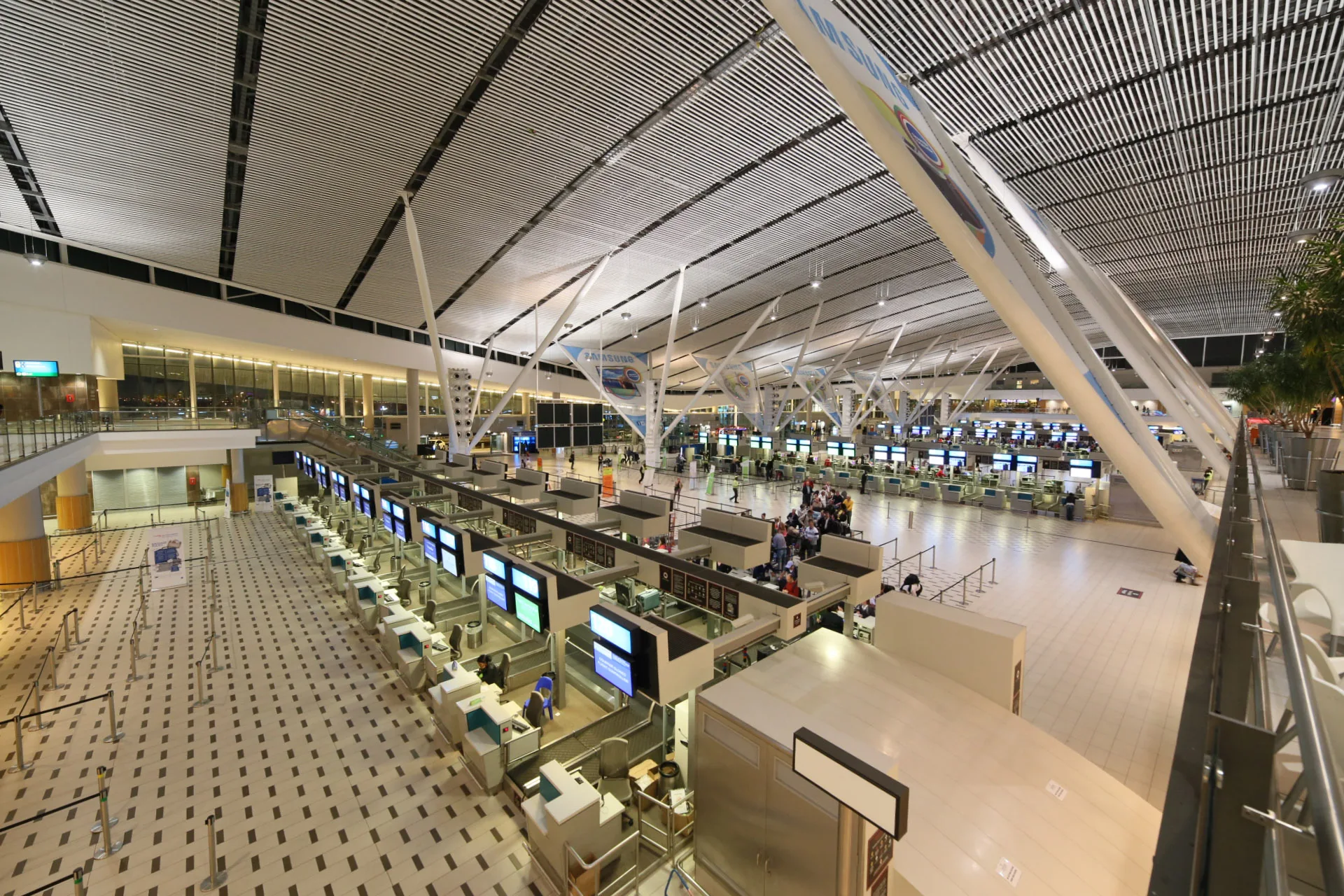
Photo: Skatebiker, Wikimedia Commons (CC BY-SA 4.0)

South Africa applies the standard international liquid rule, and applies it properly. The two things worth knowing before you pack are that every South African airport still makes you take the laptop out, and that the queue length depends far more on the hour than on the airport.
At a glance
- Liquid containers
- 100 ml maximum
- One bag per passenger
- ~1 litre
- Laptops out of the bag
- Every airport
The 100 ml rule as it is actually applied
- Containers of no more than 100 ml each. The size printed on the container is what counts, not how full it is — a half-empty 200 ml bottle is not allowed.
- All of them together in one transparent resealable bag of about a litre.
- One bag per passenger, presented separately at the belt.
Medicines and baby food are the usual exceptions, declared at the checkpoint. Duty-free liquids bought airside are sealed in a tamper-evident bag with the receipt inside; leave it sealed if you have an onward connection, or it will be taken at the next screening.
Laptops come out. Every time.
At every South African airport, laptops and large electronics come out of the bag and go in a separate tray. The computed-tomography scanners that let passengers leave electronics packed are in use in parts of Europe and North America; they are not in general use here.
Pack accordingly. A laptop at the bottom of a full bag costs you two minutes and costs everyone behind you the same two minutes.
When the queues are bad
The pinch points are specific and predictable:
- O. R. Tambo domestic, 06:00 to 08:00 — the worst in the country.
- Cape Town, Friday afternoons in December — the holiday exodus.
- Everywhere else, most of the time — short.
Mid-morning and after about eight in the evening are the quietest windows at the large airports. At the six smallest, there is effectively never a queue.
Fast track
Fast-track lanes exist at O. R. Tambo and Cape Town, attached to some premium tickets and lounge memberships. In the Johannesburg morning bank they are genuinely valuable. Outside the peaks they save a few minutes at most.
What comes out of the bag, and what stays in
South African screening is conventional, and the list is short enough to prepare for before you reach the belt rather than at it.
- Out: laptops and large tablets, in their own tray, every time. South Africa has not adopted the newer scanners that let them stay in the bag.
- Out: the liquids bag, containers of 100 ml or less in one transparent resealable bag of about a litre, one bag per passenger.
- Out: coats and belts with metal buckles.
- In: shoes, normally, unless you are asked.
- In: phones, cameras and e-readers, in most cases.
- Declare separately: medical liquids, baby food and formula. These are exempt from the 100 ml rule in reasonable quantities, but say so rather than letting them be found.
The container size is what is measured, not the amount left inside it. A half-empty 200 ml bottle does not pass. This is the single most common reason a South African screening queue stops moving.
Duty free and the connection trap
Here is the one that costs people a bottle of wine they have carried for eleven hours. If you buy liquids airside at your departure airport and then pass through security again during a connection, those liquids meet the 100 ml rule a second time — and lose.
That applies at O. R. Tambo in both directions: on an international-to-international transfer there is a security re-screening in Terminal A, and on an international-to-domestic connection you clear customs and then screen again in Terminal B. A sealed tamper-evident bag with the receipt inside is sometimes accepted and is never guaranteed. If the bottle matters, put it in checked baggage.
The inverse is also worth knowing: on a straight domestic flight with no onward screening, the purchase is fine, and the South African wine bought at Cape Town airport genuinely does reach Johannesburg.
Screening is not customs
These are two different checks run by two different authorities, and conflating them produces most of the anxiety travellers bring to a South African airport.
Security screening is about what could be dangerous on an aircraft: liquids, sharp objects, batteries. It happens on departure and it does not care what your possessions are worth.
Customs is about what you are bringing into or out of the country and what it is worth: the R5,000 duty-free allowance, the cumulative tobacco and alcohol limits, currency and restricted goods. It happens after baggage reclaim on arrival, and since 1 July 2026 it begins with an online Traveller Declaration submitted before you travel. How that works, and what the allowances actually are.
Common questions
What are the liquid rules at South African airports?
Containers of no more than 100 ml, together in one transparent resealable bag of about a litre, one bag per passenger. The container size printed on the bottle is what counts, not how full it is.
Do I need to take my laptop out at South African security?
Yes, at every South African airport. The scanners that allow electronics to stay in the bag are not in general use here.
How long are security queues at O. R. Tambo?
Worst between 06:00 and 08:00 on the domestic side. Mid-morning and after 20:00 are the quietest windows.
Can I take duty-free liquids through a connection?
Yes, if they stay in the sealed tamper-evident bag with the receipt inside. Open it and the contents will be taken at the next screening.
Checked 1 November 2026. Where a figure moves — a fare, a tariff, an opening hour — we say so rather than publish a number we cannot stand behind today. How we source and check everything on this site.
Can I take duty-free wine through a connection in Johannesburg?
Not reliably. If you pass through a security screening again — which you do on an international-to-international transfer in Terminal A and again on an international-to-domestic connection in Terminal B — the bottle meets the 100 ml rule a second time. A sealed tamper-evident bag with the receipt is sometimes accepted and never guaranteed. Put it in checked baggage.
Are baby food and medicines exempt from the liquid rule?
In reasonable quantities, yes, as at most airports. Declare them at the belt rather than letting them be found, and carry prescription medication in its original packaging with the prescription or a doctor’s letter, particularly for anything controlled.
Is security screening the same as customs?
No. Screening happens on departure and is about what could be dangerous on an aircraft. Customs happens after baggage reclaim on arrival and is about what you are bringing in and what it is worth. Different authorities, different rules, different stages of the journey.