Since 1 July 2026 everybody entering or leaving South Africa is required to submit an online Traveller Declaration before they travel — and the South African Revenue Service has stated that nobody will be refused entry or departure solely for not having done it. Both halves of that sentence are true, they come from the same official source, and almost every account of the new rule gets one half or the other wrong. This page explains what the declaration is, when to submit it, who is exempt, what the customs allowances actually are, and what the practical consequence of skipping it would be.
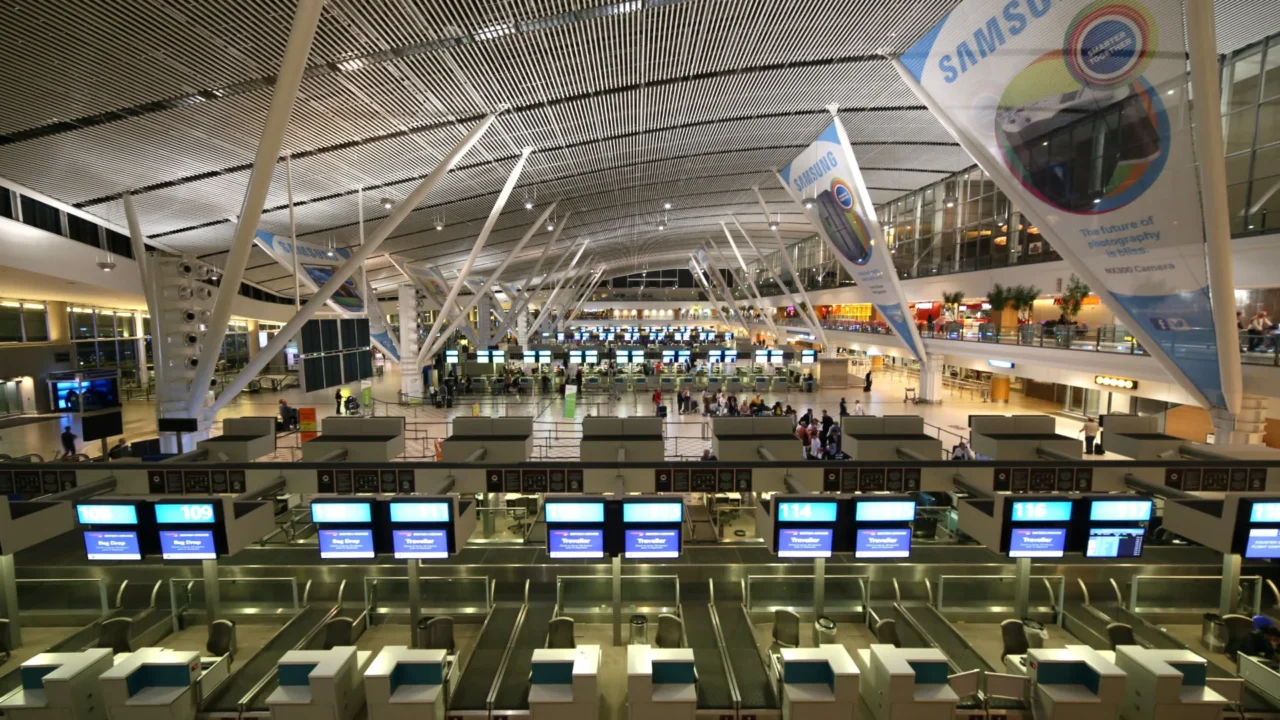
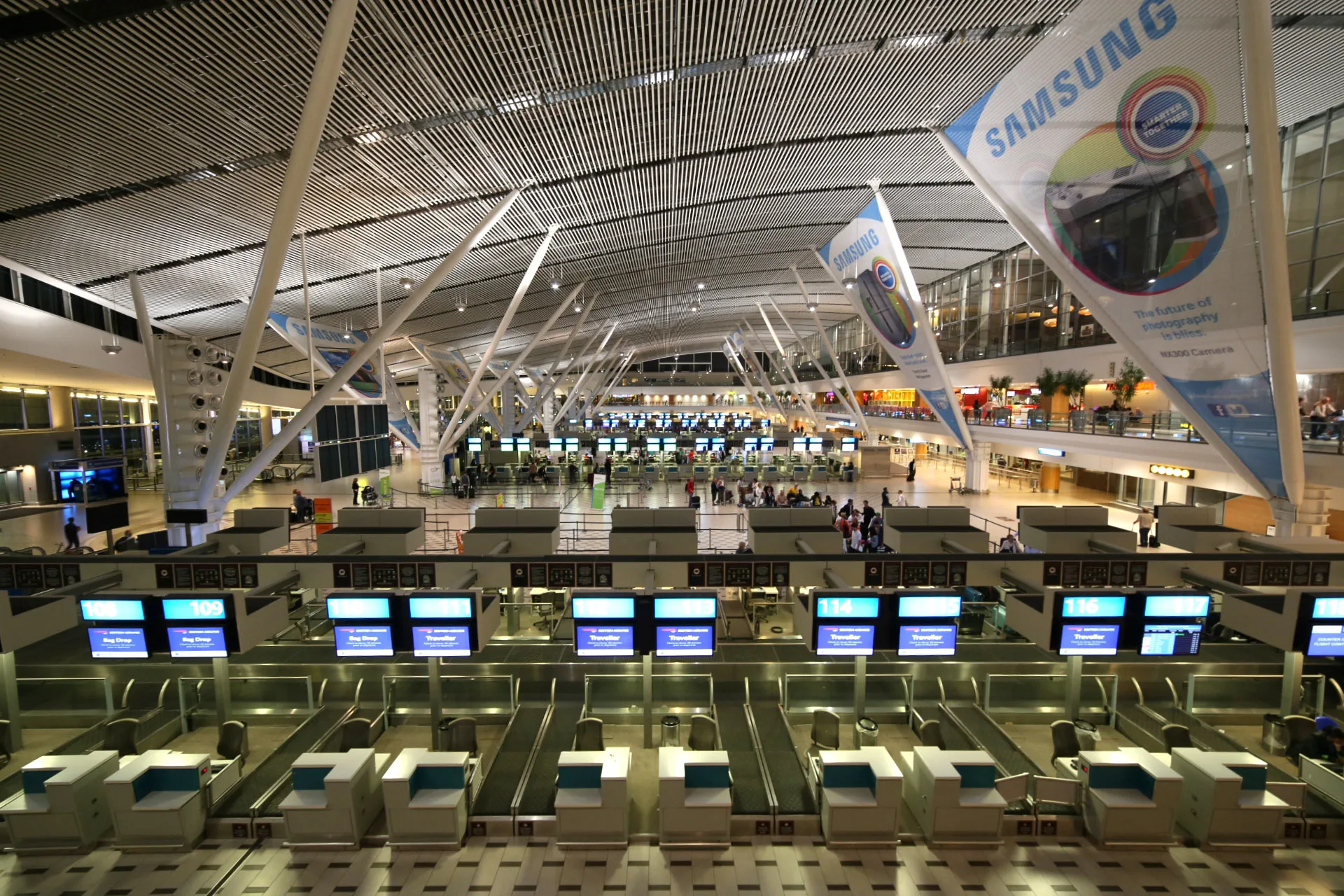
Cape Town International
Photo: Skatebiker, Wikimedia Commons (CC BY-SA 4.0)

At a glance
- Required since
- 1 July 2026
- Who
- Everyone entering or leaving, including children
- When
- No more than 24 hours before departure
- Exempt
- Air and sea passengers who stay in transit
- Refused entry if not done?
- No, by SARS’s own statement
- Duty-free goods allowance
- R5,000, once per 30 days
What the Traveller Declaration is
It is an electronic customs declaration, made in advance, that replaces the paper form travellers used to fill in on the aircraft or at the counter. It runs on the South African Traveller Management System, which SARS piloted on a voluntary basis at the major airports from 2022 and made a requirement from 1 July 2026.
The requirement applies to travel by air, land, sea and rail, in both directions, and to everybody: South African citizens, permanent residents and foreign visitors alike. It is a customs declaration, not an immigration one — it does not replace a visa, a passport check or anything the Department of Home Affairs asks for.
When to submit it: the 24-hour window
This is the detail most often reported vaguely, and SARS is precise about it. The declaration must be submitted no more than 24 hours before departure from the country from which you are travelling. It is not a form you fill in a month ahead when you book.
On a journey with stops, the window applies to the last leg directly to South Africa. So if you are flying Toronto to Frankfurt to Johannesburg, the clock runs from the Frankfurt departure, not the Toronto one. For rail travellers the declaration should be made before reaching the first or last railway station inside the country, depending on the direction of travel.
In practice: do it the evening before you fly, with your passport in front of you, and save the confirmation to your phone. Doing it at the airport is possible but it is one more thing to do in a queue.
Who does not have to do it
There is one clean exemption, and it is worth knowing because it affects a large number of people passing through O. R. Tambo. Air and sea travellers who are only transiting, and who do not leave the designated transit area, do not need to submit a declaration.
That is the test: not whether your ticket says transit, but whether you physically leave the transit area. A passenger flying London to Johannesburg to Mauritius who stays inside Terminal A is exempt. A passenger on the same aircraft who is continuing to Cape Town on a domestic flight is not exempt, because South Africa requires arriving passengers to clear immigration and collect their checked baggage at the first point of entry. They have entered the country, whatever their final destination is.
Children are not exempt. SARS is explicit: each traveller must be covered by a declaration, including children and infants. A parent, guardian or other assisting person completes it on their behalf and is responsible for its accuracy.
What happens if you have not done it
This is the question everybody has, and the answer is unusually clear because SARS has put it in writing. Travellers will not be denied entry into or departure from South Africa solely because they have not completed a declaration before arriving at a port of entry. Officials and self-service terminals at the port can help you complete it there.
That is a statement about the act of declaring in advance. It is emphatically not a statement that declaring does not matter. The enforcement language sits alongside it and is about the contents: failing to declare goods, currency or other relevant items, or making a false declaration, may lead to delays, and may also result in the detention or forfeiture of goods, penalties, or other enforcement action under customs legislation.
The honest summary: arriving without having filled in the form is an inconvenience. Arriving having filled it in wrongly — understating what you are carrying, or leaving out currency — is a customs offence. The risk was never in the form. It is in what the form says.
How to submit it
- Choose a channel. The SARS website through the Traveller Management System, the SATMS mobile app, the SARS MobiApp, or a QR code. Self-service kiosks exist at some ports of entry.
- Have the details ready. Passport or travel-document details, your travel details, contact details, and the details of anyone travelling with you whose declaration you are completing.
- Declare goods, not your luggage. Ordinary personal effects for your own use do not need to be declared. What needs declaring is goods above the allowances, commercial goods, and currency over the limit.
- Submit and keep the confirmation. SARS emails an electronic confirmation with instructions for your port of entry or exit. Keep it on your phone or print it.
- Update it if anything changes before you clear customs.
A paper declaration still exists, but only in limited circumstances: a SARS systems failure, no internet access at the place of entry or exit, or where a traveller is otherwise reasonably unable to submit electronically. Those forms are completed in the customs processing area.
The duty-free allowances, correctly
The declaration is only as useful as your understanding of what it is asking. South Africa’s traveller allowances are widely misreported, and one error in particular appears on travel sites everywhere.
Tobacco and alcohol are cumulative, not alternatives
You will often read “200 cigarettes or 20 cigars”. That is wrong. SARS lists the consumable allowances as a set you receive together:
- 200 cigarettes and
- 20 cigars and
- 250 g of pipe or cigarette tobacco and
- 2 litres of wine and
- 1 litre of other alcoholic beverages in total, beer included, and
- 50 ml of perfume plus 250 ml of eau de toilette.
The perfume line is the other one people get wrong. Eau de toilette has its own allowance of 250 ml, five times the perfume one, and it is additional rather than part of it. Tobacco and alcohol allowances do not apply to travellers under 18; the goods allowance does.
The R5,000 goods allowance has two conditions
New or used goods up to R5,000 per person come in free of duty and VAT. But the allowance is granted once per person in a 30-day cycle, and only after an absence of 48 hours or more. A day trip across a border does not earn it, and a second trip inside the month does not earn it again. Allowances are per person and cannot be pooled between members of a family.
Above R5,000 there is a flat rate, and then a ceiling
Beyond the duty-free allowance you may bring in additional new or used goods up to R20,000 at a flat rate of 20 per cent, with VAT also exempted. Unlike the duty-free allowance, the flat rate may be used an unlimited number of times within the 30-day cycle, provided the total does not exceed R20,000.
Above that the ordinary customs duties and VAT apply. The overall ceiling for consumables, the duty-free allowance and the flat-rate goods together is R25,000.
Arriving from a neighbour is different
Travellers arriving from the other members of the Southern African Customs Union — Botswana, Lesotho, Namibia and Eswatini — are treated differently, with a VAT exemption on goods up to R25,000 rather than R5,000, and the flat rate does not apply. This is the single most valuable thing to know if you are driving in from Gaborone or Maseru rather than flying in from abroad.
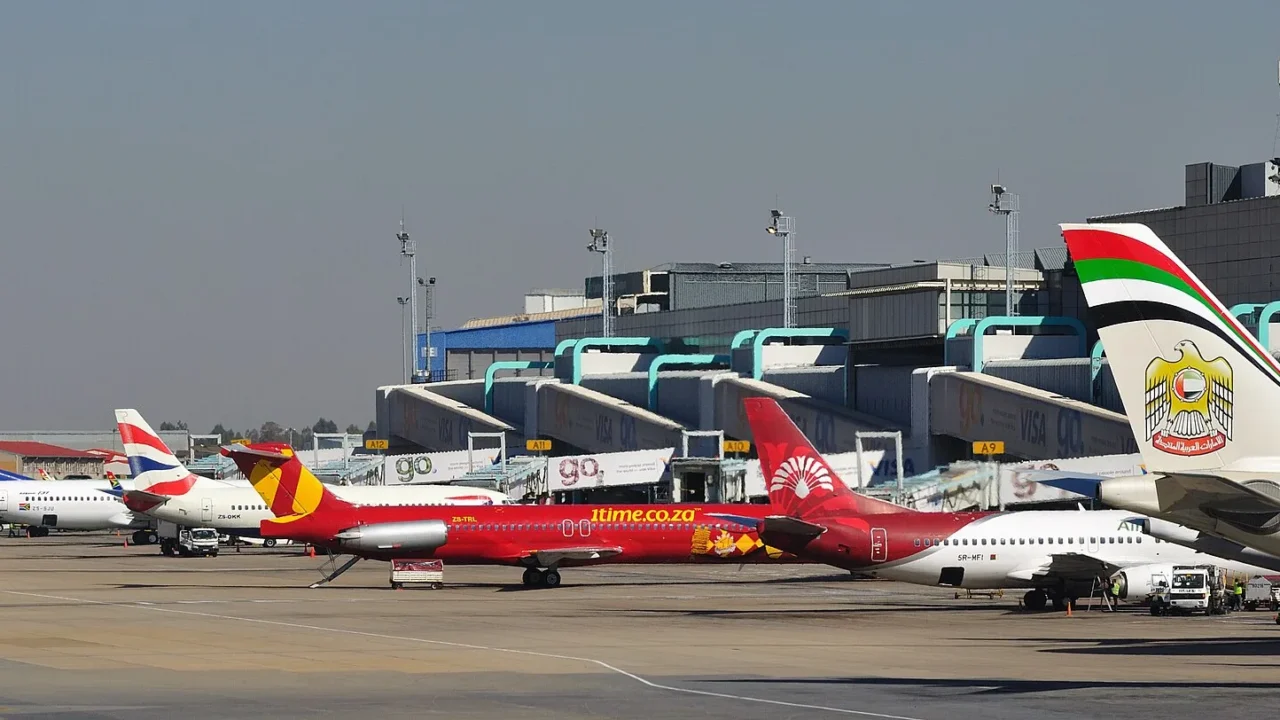
Arrivals
Photo: Hansueli Krapf, Wikimedia Commons (CC BY-SA 3.0)

Currency: the figure where sources disagree
Here we are going to show our working rather than pick a number, because the official sources themselves do not agree.
The current SARS guidance for the Traveller Declaration gives the limit as R100,000 without prior approval. An older SARS traveller leaflet, still circulating widely and still quoted by travel sites, gives R25,000 in rand with unlimited foreign currency subject to declaration. The newer figure is on the page that accompanies the system you are actually required to use, and it is the one we would plan to; but if you are carrying an amount anywhere near either threshold, read the current SARS page for yourself on the day rather than trusting any secondary source, this one included.
What is not in dispute is that undeclared currency is one of the things customs is actively looking for, and that the penalty for getting it wrong is detention or forfeiture rather than a polite correction.
Green channel, red channel
Whatever you declared electronically, the physical decision still has to be made in the hall, and it is made by you rather than by the system.
The declaration does not remove the channels. After baggage reclaim you still choose between the green channel, for nothing to declare, and the red channel, for goods above the allowances, commercial goods or anything you are unsure about.
SARS’s own guidance makes a point that is worth repeating because it is genuinely reassuring: uncertainty itself is a reason to use the red channel. If you do not know whether something counts, declaring it is not an admission of anything. Walking through the green channel with it is the act that creates the offence.
The practical test is simple enough to apply while tired. If you would have to explain or justify something to an officer who found it, declare it. If the honest answer to “is this worth more than the allowance?” is “I am not sure”, declare it. Nothing in the red channel costs you anything except time, and the time is usually a few minutes.
Being selected for inspection in the green channel is not an accusation either. Selection happens on profiling and at random, and at O. R. Tambo in the morning bank it happens a great deal. It adds minutes, not hours, if your declaration matches your bag.
Leaving South Africa, and the VAT refund
The declaration is a two-way requirement, which surprises people: you submit one on the way out as well as on the way in. For most departing visitors that is a formality, but it has one practical use that is worth money.
Foreign visitors can reclaim the 15 per cent VAT paid on goods they are taking home, and under the new system the route runs through the declaration: you declare the goods online, then complete the customs verification at the port of departure. The practical implications have not changed. You need the original tax invoices, the goods must be with you and available for inspection, and you must allow time — the verification happens before you check the goods in if they are going into the hold, which means arriving earlier than you otherwise would.
Declaring the goods on the way out is also what establishes that an expensive item left the country with you. If you are travelling with camera equipment, a laptop or jewellery that you brought in, the departure declaration is the record that it was yours, not something bought locally.
What you should not try to bring in
Separate from allowances, which are about value, there is a category of goods that is prohibited or restricted regardless of how little it is worth. The declaration asks about these, and this is where a careless answer causes real trouble.
- Plants, seeds, fruit and other plant material. South Africa has an agricultural economy to protect and takes this seriously. The apple in your hand luggage is a genuine problem, not a technicality.
- Meat, dairy and other animal products. Same reasoning, and the restrictions tighten whenever there is a disease outbreak anywhere in the region.
- Anything from an endangered species. Ivory, rhino horn, reptile skins, certain corals and shells, and products made from them are controlled under the international CITES convention. Souvenirs bought elsewhere in Africa are the usual way travellers fall into this.
- Firearms and ammunition, which require a permit arranged in advance, not a conversation at the counter.
- Counterfeit goods, which are seized and destroyed.
- Medicines beyond a personal supply. Carry prescription medication in its original packaging with the prescription or a doctor’s letter, particularly for anything controlled.
Those categories are set by several agencies rather than by customs alone, and the detail changes. Read the current SARS prohibited-and-restricted guidance before you pack anything in those categories, and when in doubt use the red channel, which is precisely what it is for.
What actually changed, and why
It is easy to read the new requirement as another layer of bureaucracy. In substance it is a change of timing rather than of obligation. Travellers arriving in South Africa have always been required to declare goods above the allowances; what changed on 1 July 2026 is that the declaration is made before you travel and in a form a computer can read, rather than on a slip of paper handed to an officer at the end of a long flight.
From the traveller’s side the honest assessment is mixed. It is one more task before a journey. In exchange, the customs hall deals with a known set of declarations rather than a stack of handwritten forms, which is the mechanism by which the green channel gets faster rather than slower. Whether that improvement arrives is a question for the next year of data rather than for a launch announcement, and we will say so here when there is something measurable to say.
One further point of context. The system was piloted voluntarily at the major airports from 2022, so the infrastructure at O. R. Tambo and Cape Town is four years old rather than four months old. The land borders are where the change is newest and where the queues are most worth allowing extra time for.
What this means for your connection
If you are connecting onto a domestic flight, the declaration is one more reason to treat the O. R. Tambo transfer seriously. You are not in transit for customs purposes: you clear immigration, collect your checked bag, pass through a customs channel and then check in again in the other terminal. Two hours is the realistic minimum for that sequence, and sixty minutes is a missed flight. The full connection guide sets out the clock stage by stage.
If you are genuinely in transit and staying inside Terminal A, none of this applies — no declaration, no customs, no reclaim.
Common questions
Is the South African Traveller Declaration compulsory?
Yes. Since 1 July 2026 everyone entering or leaving South Africa by air, land, sea or rail is required to submit one before travelling, including South African citizens and residents. The only clean exemption is for air and sea passengers who are in transit and do not leave the designated transit area.
Will I be refused entry if I have not filled in the declaration?
No. SARS has stated that travellers will not be denied entry into or departure from South Africa solely because they have not completed a declaration before arriving at a port of entry, and that officials and self-service terminals can help at the port. Failing to declare goods or currency, or declaring them falsely, is a different matter and can lead to delay, detention or forfeiture of goods and penalties.
How far in advance do I submit the Traveller Declaration?
No more than 24 hours before departure from the country you are travelling from. If your journey has stops, the window applies to the last leg directly to South Africa. It is not something you do when you book.
Do children need a Traveller Declaration?
Yes. Every traveller must be covered by a declaration, children and infants included. A parent, guardian or other assisting person completes it on their behalf and is responsible for the accuracy of what it says.
How much duty-free can I bring into South Africa?
Goods to the value of R5,000 per person free of duty and VAT, once in any 30-day cycle and only after an absence of 48 hours or more. Above that, a flat rate of 20 per cent applies to a further R20,000 of goods, with an overall ceiling of R25,000. Consumables are separate and cumulative: 200 cigarettes and 20 cigars and 250 g of tobacco and 2 litres of wine and 1 litre of other alcohol and 50 ml of perfume plus 250 ml of eau de toilette.
Do I need a declaration if I am only changing planes in Johannesburg?
Only if you leave the designated transit area. An international-to-international connection inside Terminal A is exempt. An international-to-domestic connection is not, because South Africa requires you to clear immigration and collect your checked baggage at the first point of entry, which means you have entered the country.
Where these figures come from
Everything on this page about the declaration comes from the South African Revenue Service’s own traveller-declaration pages and its published answers to frequently asked questions about the requirement that took effect on 1 July 2026. The allowances come from SARS’s duty-free-allowances guidance. We have read those pages directly rather than quoting another travel site, and where two official sources give different figures — as they do on currency — we have said so and shown both rather than choosing one silently.
Rules of this kind change without notice, and a customs allowance is exactly the sort of figure that moves. If what you read here no longer matches SARS, SARS is right and we are out of date. Tell us and we will correct it and date the correction. Our corrections policy explains how.
Related reading: the customs allowances guide, entry and passport requirements, connecting at O. R. Tambo and how long arrivals really take.