The South Africa airport guide
Free Wi-Fi, and where the sockets are
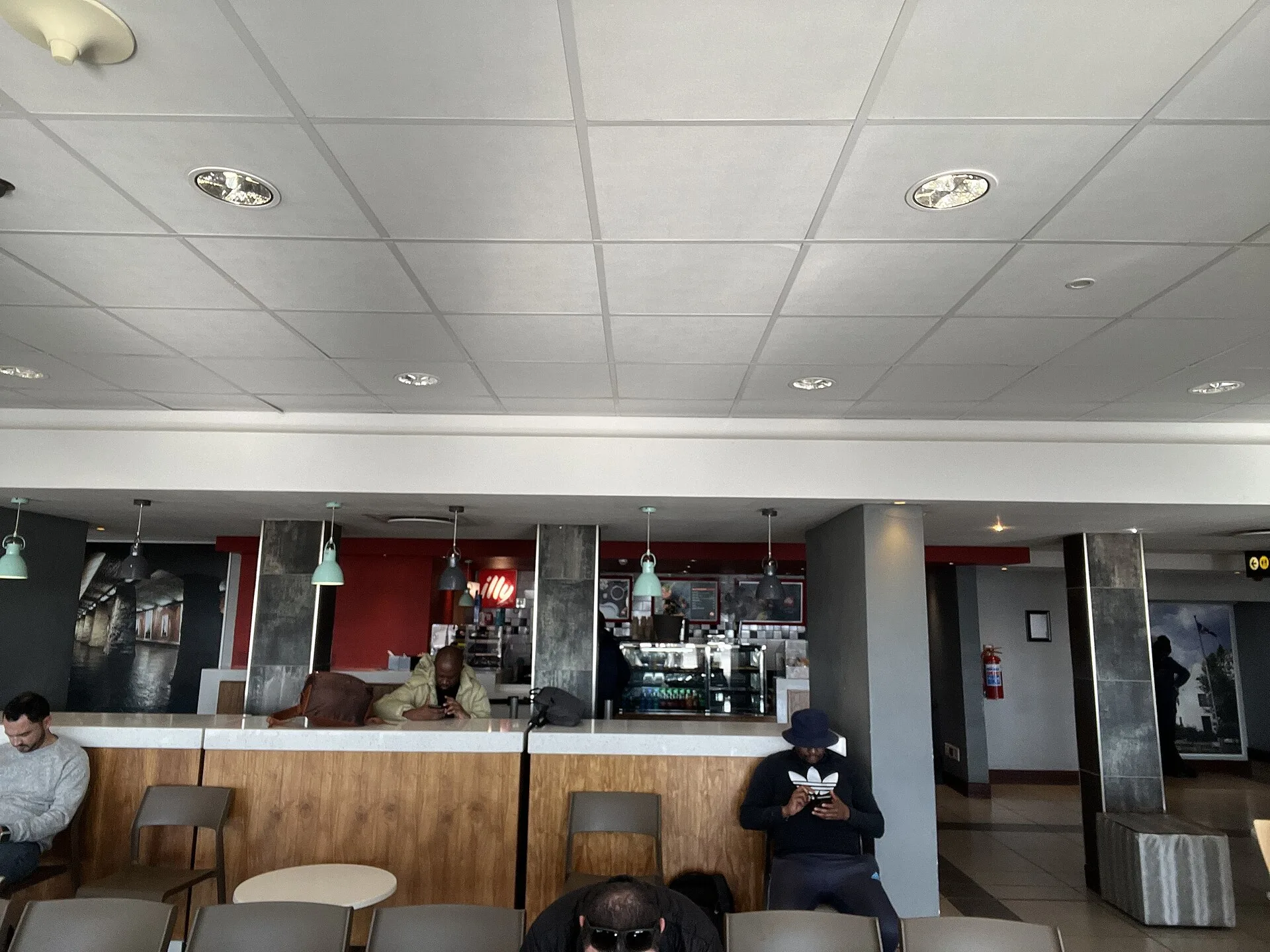
Photo: Bobbyshabangu, Wikimedia Commons (CC0)

South African airports give you free Wi-Fi with a data cap rather than a time limit — the opposite of most European airports. And the plug you need is one almost no other country uses, which is the thing most visitors discover too late.
At a glance
- Free Wi-Fi
- Data-capped, not time-capped
- Socket type
- Type M (and Type N)
- Mains voltage
- 230 V, 50 Hz
Data-capped, not time-capped
The ACSA airports offer free Wi-Fi limited by how much you download rather than how long you stay connected. The allowance is comfortable for messaging, email, boarding passes and maps. It is not enough for video.
Beyond the allowance you buy more or tether to a mobile connection. A local SIM or eSIM is usually cheaper than airport Wi-Fi top-ups if you are staying more than a couple of days.
The plug: Type M, and why it matters
South Africa uses the large three-pin Type M socket at 230 V, 50 Hz. It is physically distinct from the British, European and American standards, and almost no other country uses it.
Newer buildings also fit the slim Type N socket and sometimes the European Type C, but the terminals are not consistent and you cannot plan around it. A universal adapter bought before you travel is a small problem solved; bought at an airport it costs several times as much.
Finding a socket
Purpose-built charging columns exist at O. R. Tambo and Cape Town, and are outnumbered by passengers at peak times. The reliable fallback is an airside restaurant or café: buy a coffee and use the wall.
At the smaller airports there are fewer columns but also far fewer people competing for them.
Power cuts
South Africa has a history of scheduled electricity shedding. The airports run on backup supply and keep operating through it — flights are not affected — but a hotel or restaurant outside the airport may be on a different footing. Charge when you have the chance rather than when you need it.
What a data cap means in practice
South African airport wi-fi is free and capped by volume rather than by time, which is the opposite of the European model and changes how you should use it.
A volume cap is generous for the things you actually need at an airport and useless for the thing you might want to do with three hours to spare. Messages, email, a boarding pass, a map, a booking confirmation and a video call of modest length all fit comfortably. A film does not. Nor does a large software update, which is the most common way travellers exhaust the allowance without noticing — turn automatic updates off before you connect, not after.
Two habits make the difference. Download what you need before you leave the hotel: boarding passes as screenshots, maps offline, anything you intend to read. And treat the airport network as a convenience rather than infrastructure — a local SIM or an eSIM, bought on arrival or before you travel, is what carries you through the rest of the trip.
Load-shedding, and why it rarely affects you at the airport
Scheduled power cuts have been part of South African life for years, and visitors reasonably wonder what that means for a flight.
At the airport itself, very little. Airports are critical infrastructure with their own generation, so terminals, screening, air traffic services and the aircraft themselves are not affected in the way a restaurant or a shopping centre is. What can be affected is the journey to the airport: traffic lights out across a city turns every intersection into a four-way stop and adds unpredictable time to a road transfer.
The practical response is about the transfer rather than the terminal. Leave earlier than the map says on a day with cuts scheduled, and remember that the Gautrain at O. R. Tambo is not a road and is not subject to the same problem.
Power: the plug nobody owns
South Africa uses the large three-pin Type M socket at 230 V, 50 Hz. It is unusual, it is physically big, and the universal travel adapter in your bag may well not carry it — a great many of them cover Type C, G, A and I and stop there.
Newer buildings, including the major airports, also fit the smaller Type N socket alongside it, and many hotels now provide USB sockets directly. None of that is something to rely on for a flight you need a boarding pass to board. Buy the adapter before you travel, or at the airport on arrival, and carry a power bank: charging columns in the public areas exist and are outnumbered at peak times, and an airside restaurant table with a socket under it is the reliable fallback.
Common questions
Is airport Wi-Fi free in South Africa?
Yes, with a data cap rather than a time limit. Enough for messages, email and boarding passes; not enough for streaming.
What plug adapter do I need for South Africa?
Type M, the large three-pin socket, at 230 V and 50 Hz. Newer buildings sometimes add Type N or Type C, but not consistently. Bring a universal adapter.
Where can I charge a phone at a South African airport?
Charging columns at O. R. Tambo and Cape Town, and wall sockets in airside cafes everywhere. The columns fill up at peak times.
Checked 1 November 2026. Where a figure moves — a fare, a tariff, an opening hour — we say so rather than publish a number we cannot stand behind today. How we source and check everything on this site.
Does load-shedding affect flights in South Africa?
Not at the airport itself, which has its own generation as critical infrastructure. What it affects is the road journey to the airport: traffic lights out across a city turn every intersection into a four-way stop and add unpredictable time. Leave earlier, or use the Gautrain at O. R. Tambo, which is not a road.
How much free wi-fi do I get at a South African airport?
It is capped by data volume rather than by time, and the allowance is comfortable for messages, email, boarding passes and maps but not for streaming. The usual way people exhaust it without noticing is an automatic software update, so turn those off before you connect.
Should I buy a local SIM at the airport?
If you are staying more than a few days, a local SIM or an eSIM is worth more than any airport network, because coverage on the roads and in the parks is what you will actually need. Registration is required by law and the airport outlets handle it, so bring your passport to the counter.