CPTFACT
Cape Town International Airport
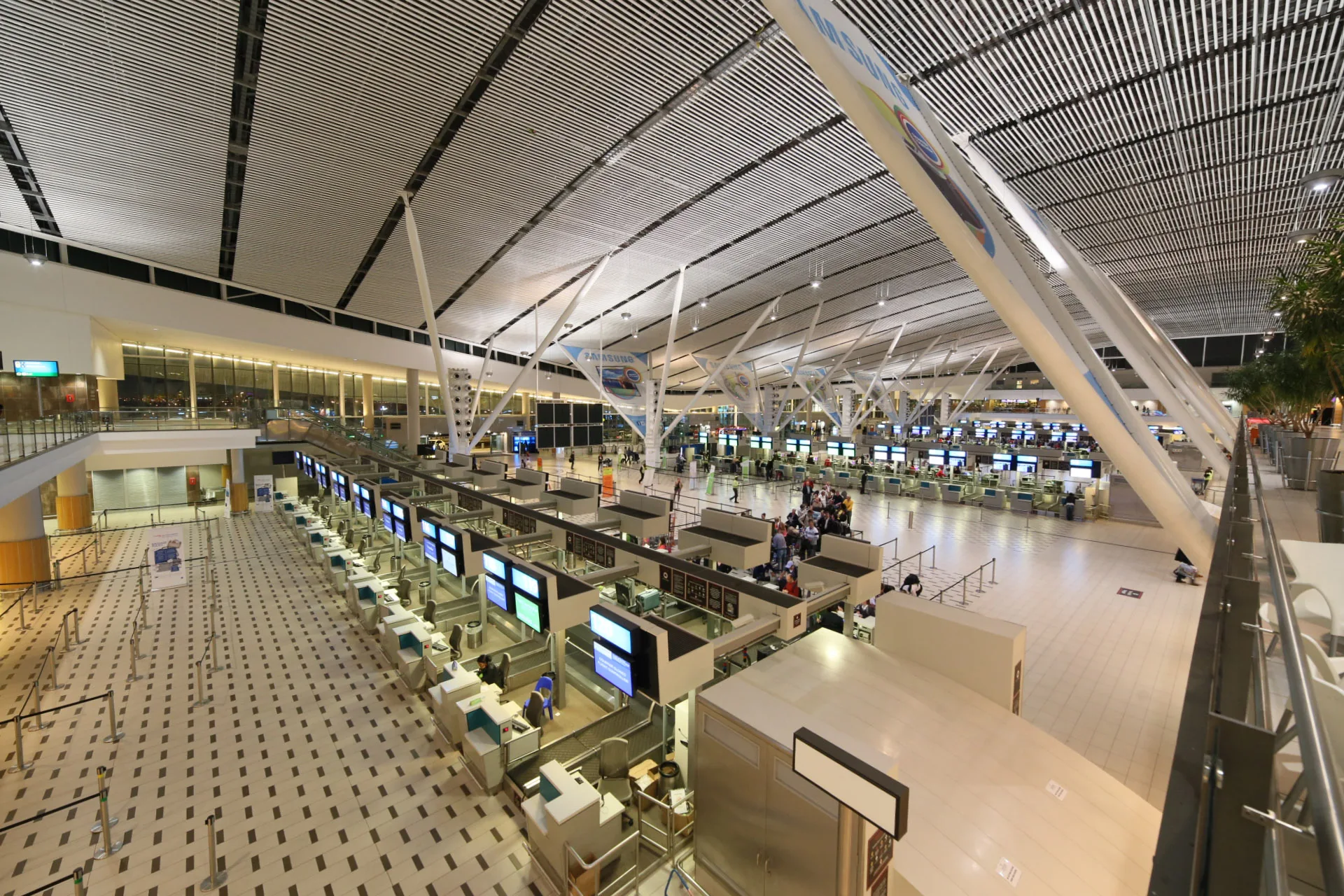
Photo: Skatebiker, Wikimedia Commons (CC BY-SA 4.0)

Cape Town International is the airport travellers rate most highly in South Africa, and the one growing fastest among the big three. It handled 11,333,736 passengers in the 2025/26 financial year. One terminal, two piers, and twenty to thirty minutes from the city bowl when the N2 behaves.
From the operator’s monthly filings · FY2025/26
- 11,333,736passengers, FY2025/26
- +8%against the previous year
- 27.6%of them international
- Decemberbusiest month
- Junequietest month
- 20 kmto Cape Town
One building, which is why connections are quick
Cape Town is a single terminal with domestic and international piers either side of a shared central hall. There is no inter-terminal walk, no shuttle, and no second building to find. That is the whole reason connections here feel so much easier than at O. R. Tambo.
An international-to-domestic connection still means clearing immigration, collecting your bag and checking it in again — but the walk between the two is minutes rather than a trek. Ninety minutes is realistic; two hours is relaxed.
One runway that matters, and what that means in winter
Cape Town has two runways on paper. In practice 01/19, at 3,201 m, carries essentially all the traffic; the second, 16/34, is 1,701 m and too short for the jets. So when weather closes 01/19 there is nowhere to switch to.
Cape Town is a winter delay problem, not a summer one. The north-westerly fronts that arrive between May and August bring crosswind and low cloud to a single usable runway. If you are flying in those months, a morning departure is a safer bet than an afternoon one. Johannesburg has the opposite pattern: its risk season is the Highveld thunderstorms from November to March.
Getting into the city
There is no train. Cape Town International has no rail link of any kind — the Gautrain is a Gauteng system, 1,400 km away. The options are a metered taxi from the official rank, an e-hailing car from the signed pick-up bay, a hotel shuttle, or a hire car.
The city bowl is about twenty kilometres and twenty to thirty minutes off-peak. The N2 at rush hour can double that. E-hailing pick-up is confined to a designated bay that is not always where the app drops its pin — follow the airport signs rather than the map.
Cape Town is also the gateway to the Winelands (Stellenbosch and Franschhoek, about forty minutes), the Cape Peninsula and, by road, the Garden Route. A hire car earns its keep here more than at any other South African airport.
Arrivals, departures and the December problem
Domestic arrivals clear quickly: fifteen to twenty minutes with hand luggage, about thirty with a checked bag. International is slower but not as slow as Johannesburg, because fewer long-haul flights land at once.
Departures are the opposite story. December is the pinch point, and a Friday afternoon in December is the worst of it. Three hours for an international departure in that window is not excessive. The rest of the year, two hours domestic and two and a half international is comfortable. Check-in cut-offs are roughly 45 minutes domestic and 60 international.
Parking, lounges, food and Wi-Fi
Parking follows the usual three tiers — policed kerbside drop-off, covered short stay, open long stay with a shuttle. The drop-off here is enforced as firmly as at O. R. Tambo. Which tier to choose.
Lounges are a strong set for the airport’s size: Bidvest Premier with day passes at the door, Slow Lounge for the right bank card, and airline lounges including British Airways. Food is good landside and narrower airside, with the usual pattern of full-service restaurants before security and quick-service after.
Wi-Fi is free with a data cap. Charging columns exist but are outnumbered at peak times; an airside restaurant is the reliable fallback.
Month by month: when Cape Town is busy
Cape Town has the sharpest seasonal curve of the three big airports — the December peak is 46 per cent above the June trough, against about a third at O. R. Tambo.
That curve is the single most useful thing to know when booking. June is both the quietest month and the cheapest, and it is when the whale season at Hermanus begins. The trade-off is weather: June is the wet, windy end of the Cape winter, and the delay risk described above is at its highest.
Five years of traffic
Financial years, 1 April to 31 March. This is why the figure here differs from calendar-year numbers quoted in the press: Cape Town handled 11,333,736 passengers in FY2025/26 and 11,113,490 in calendar 2025. Both are correct, and they are more than 200,000 apart.
Common questions
What is the code for Cape Town airport?
CPT is the IATA code and FACT the ICAO code. The full name is Cape Town International Airport.
Is there a train from Cape Town airport to the city?
No. Cape Town International has no rail link. The Gautrain serves only O. R. Tambo, 1,400 km away in Gauteng. From Cape Town it is a metered taxi from the official rank, an e-hailing car from the signed bay, a shuttle or a hire car.
How far is Cape Town airport from the city centre?
About twenty kilometres, and twenty to thirty minutes when the N2 is clear. At rush hour, closer to an hour.
Why does Cape Town airport get so many delays in winter?
Because the north-westerly fronts of May to August bring crosswind and low cloud to an airport where only one runway is long enough for jets. When 01/19 is affected, there is no second runway to switch to.
When is the cheapest time to fly to Cape Town?
June, which is the quietest month on the airport’s own figures — 46 per cent below the December peak. It is also the wettest and the one with the highest weather-delay risk, which is precisely why fares are lower.